
When it comes to weight management for women, there really is no one-size-fits-all answer. What works for one woman may not work for another, and the reasons we struggle with our weight can be very different, too. For some, it may be about finding an approach to eating that works for them. For others, hormonal changes, emotional eating, cravings or long-standing habits can make things more complicated.
There are different options for weight loss options, from nutritional support and medical treatments to approaches that help us better understand our relationship with food. The important thing is finding what feels right for you, your circumstances and your needs. In this article, we’ll explore some of these options, including where clinical hypnotherapy may help and where it has its limitations.
Why Weight Management Looks Different for Every Woman
The role of hormones, life stage and emotional patterns
Hormones and life stage shape how a woman's body works. Puberty, pregnancy, postpartum, perimenopause and menopause can all affect appetite, energy and where the body stores weight. Conditions such as PCOS and thyroid problems can play a part too. Jean Hailes for Women's Health has clear, women-specific information on how hormones and health connect.
Our relationship with food can be influenced by much more than hunger. Stress, tiredness, loneliness and difficult emotions can all affect how and when we eat. Sometimes, food becomes a way of coping with how we're feeling, often without us even realising it.

Why the same approach doesn't work for everyone
Two women can try the same approach and have very different experiences. Health history, hormones, medical conditions, daily routines and emotional patterns all differ. An approach that suits one woman's life may not suit another's. That's why a balanced comparison is more useful than a single recommendation.
What Does the Evidence Say About Each Approach?
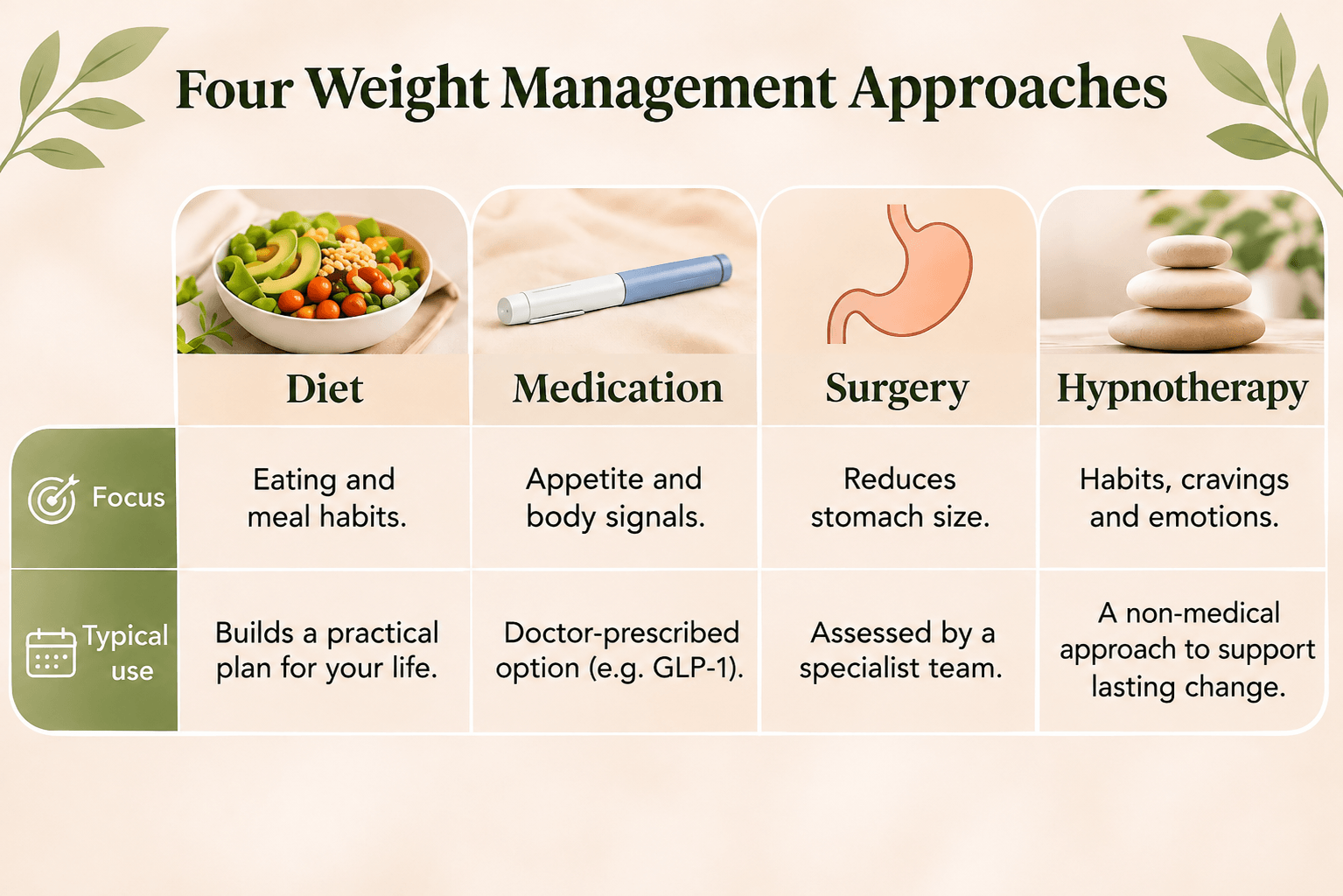
Here's a simple summary of the four common approaches before the detail.
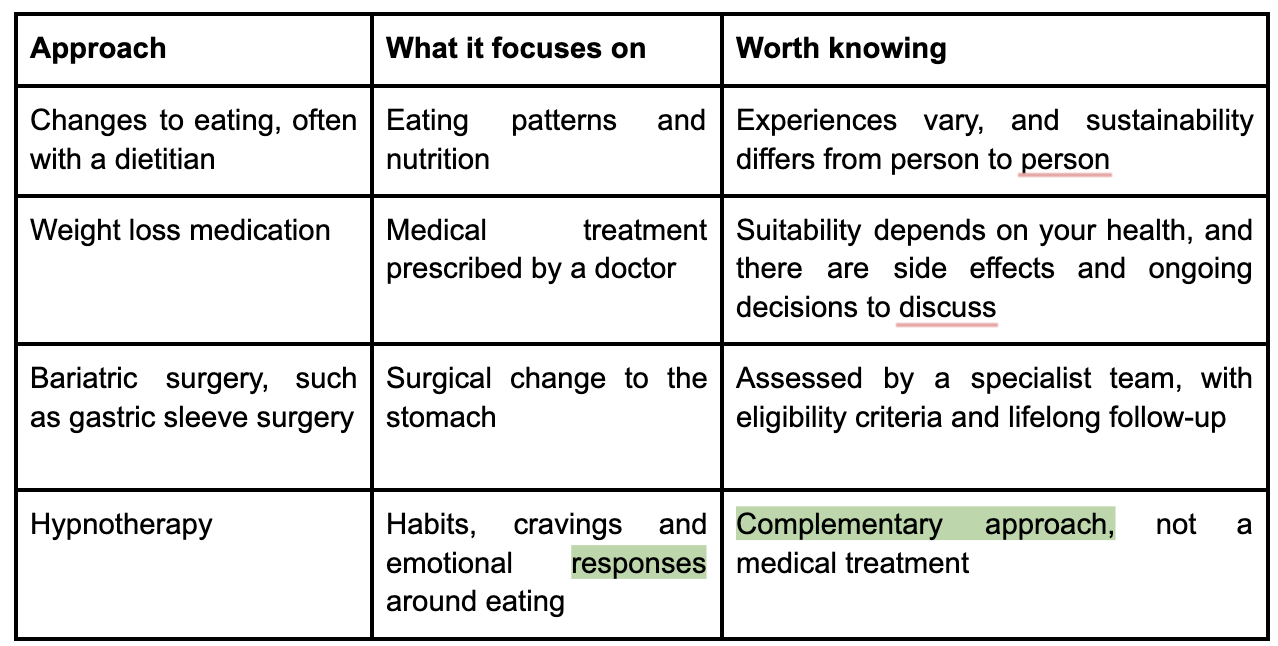
Changes to eating. Working with an Accredited Practising Dietitian can help you build eating and meal plans that suit your health and life. Many people find the hardest part isn't knowing what to do, it's keeping it going over time. Results and sustainability vary.
Weight loss medication is available in Australia through prescribing doctors, including GLP-1 medications. Whether it's suitable depends on your health history, and it comes with possible side effects. Some people find their weight returns if they stop, so how long to use it is a decision to make with your doctor. This is a legitimate option, and it's one to discuss with your GP.
Bariatric surgery - Gastric sleeve surgery reduces the size of the stomach. Healthdirect Australia has a guide to bariatric surgery and a page on gastric sleeve surgery that explain who it may suit, how it works and the risks. It's assessed by a specialist team, and long-term follow-up and nutrition support are part of it. Again, it's a legitimate choice for some people.
Hypnotherapy. Hypnotherapy is a viable non-medical weight loss treatment. It works with habits, cravings and emotional responses around eating. Research on hypnotherapy for weight is mixed, and it's best understood as supporting and drving change, not as a replacement for medical advice. That's the honest picture.
A Note From Katarina: Choosing What's Right for You
Kat's own reflections on supporting women through this decision
I believe it's important for women to feel comfortable in their own bodies. Long gone, hopefully, are the days of extremely thin models creating unrealistic expectations of what women should look like. Today, we're increasingly seeing models of different shapes and sizes, reflecting a much more realistic picture of women and the world we live in.
We are all different, not just in our personalities, but in our bodies too. Our genetics, body composition, metabolism, lifestyles and individual circumstances are unique. And that's precisely why I believe there is no single 'right' answer when it comes to weight management.
Working with clients in this area, I've noticed that there is often an emotional component to the extra weight women carry. Of course, it is possible to lose weight by counting calories or following a restrictive diet. However, maintaining those changes can require enormous effort if the underlying patterns or reasons influencing our eating habits haven't been acknowledged and addressed.
And here's the thing: our system isn't necessarily wired to go the extra mile when things get tough. Quite the opposite. When stress or other challenging circumstances arise, we often revert to familiar ways of coping. The mind and body tend to favour what is familiar and requires the least effort, particularly when we're feeling overwhelmed or under pressure. In those moments, we naturally look for comfort, familiarity and a sense of safety, even when our usual responses may not be serving us particularly well.
This is often where the real challenge lies. A stressful situation, an emotional setback or simply feeling overwhelmed can leave us feeling less resourceful. Before we know it, we're reaching for comfort, whatever that might look like for us. It could be food, sugar, a particular snack, or that extra glass of wine or simply slipping back into habits we've been trying to change.
This is one of the areas where hypnotherapy can make a meaningful difference. Rather than focusing solely on what we eat or how much we exercise, it helps address the underlying emotional responses, subconscious patterns and behaviours that can influence our choices. By working with these patterns, the aim is to make healthier responses feel more natural and easier to maintain, even when unexpected or stressful situations arise.
I genuinely enjoy working with clients who want to manage their weight more effectively, and I always encourage them to explore the approach that is most appropriate for their individual needs and goals.
More often than not, the answer involves a combination of things. For some, it may mean exploring medication, such as GLP-1 treatments, alongside hypnotherapy. For others, it might involve following a particular dietary approach, making changes to eating habits or increasing physical activity. There is no need to rule out one approach in favour of another.
Whatever path you choose, hypnotherapy can be a valuable addition to your weight management journey. By addressing the emotional and subconscious patterns that may be getting in the way, it can help you build a different relationship with food, develop more helpful responses to stress and make lasting changes feel more achievable.
Because sometimes, the most important part of managing our weight isn't simply changing what we do. It's understanding what's driving our behaviour in the first place and transforming those patterns so they work in our favour.

How Hypnotherapy Can Support Weight Management, Whichever Path You Choose
Using hypnotherapy alongside medical or surgical approaches
If you're taking medication or have had or are considering surgery, hypnotherapy can sit alongside it. Medication and surgery work on the body. Hypnotherapy works on habits and emotional patterns, which are often a separate part of the picture. It's best to let your doctor or specialist team know you're doing it, as it doesn't replace their advice, and combining these approaches can accelerate recovery, healing and overall outcome.
Using hypnotherapy as a standalone approach for sustainable habit change
For some women, the main challenge is the pattern around eating, such as eating in response to stress or feelings. Hypnotherapy for emotional eating works with that pattern at the subconscious level, and hypnotherapy for cravings works with the urge itself. This is the focus of weight management hypnotherapy at our clinic. Our guide on subconscious patterns and hypnotherapy explains how this works, and our Addictions & Habits service page covers habit-based patterns in more detail. If the emotional side of body image is part of it for you, our Self-Esteem & Confidence service page may help.
Getting Started With a Personalised Approach at The MindShift Clinic
We take a personalised approach, and are always guided by you. If you'd like to talk through where you are and what might help, we offer a free consultation. Our What To Expect page explains how it works, and you can read more about Katarina McNamara. For emotional eating hypnotherapy Sydney women can book with us in Balgowlah or Allambie Heights on the Northern Beaches. See our Weight Management service page for more, or book a free consultation to get started.
Frequently Asked Questions
-
There's no single best option. It depends on your health, history, goals and what's gone before. A conversation with your GP is a good starting point for medical options, and hypnotherapy can complement any of them by supporting habits and emotional patterns.
-
Yes, it can complement medication or surgery by supporting habits, emotional patterns around eating and any related anxiety. It doesn't replace medical advice, so let your doctor or specialist team know you're doing it, and follow their guidance.
-
Hypnotherapy doesn't give you a set of food rules or a prescribed meal plan to follow like a dietitian might do. Instead, we work together to review your goals and identify the habits, cravings and emotional patterns that may be influencing your eating behaviours. The focus is on addressing and transforming the patterns behind the behaviour, rather than simply providing a food plan to follow.
-
Hormones and life stage, such as pregnancy, perimenopause and menopause, can affect appetite, energy and how the body stores weight. Conditions like PCOS can too. What suits one stage of life may not suit another, so it's worth considering where you are now.
-
If you often eat in response to stress, boredom or difficult feelings, rather than hunger, emotional eating may be part of the picture. It's very common, and there's no judgement in it. A free consultation is a good way to talk it through.