
Why Willpower Isn't Enough: How Hypnotherapy Works With Subconscious Patterns
Changing familiar habits can feel difficult, even when you genuinely want to. Much of what we do each day runs on automatic thoughts and responses, and these subconscious patterns can play a large part in why old habits persist. Hypnotherapy uses focused attention and therapeutic suggestions to help you explore and practise different ways of responding.
If you've ever known exactly what you want to do differently and still found yourself repeating the same habit, thought or reaction, you'll know that intention alone doesn't always make change easy. That isn't a sign of weakness or a lack of commitment. It's a reflection of how the mind is built. Here at The MindShift Clinic on Sydney's Northern Beaches, it's one of the most common experiences people describe when they first come to see us, and understanding it is often the first step toward shifting it.
What Are Subconscious Patterns, Really?
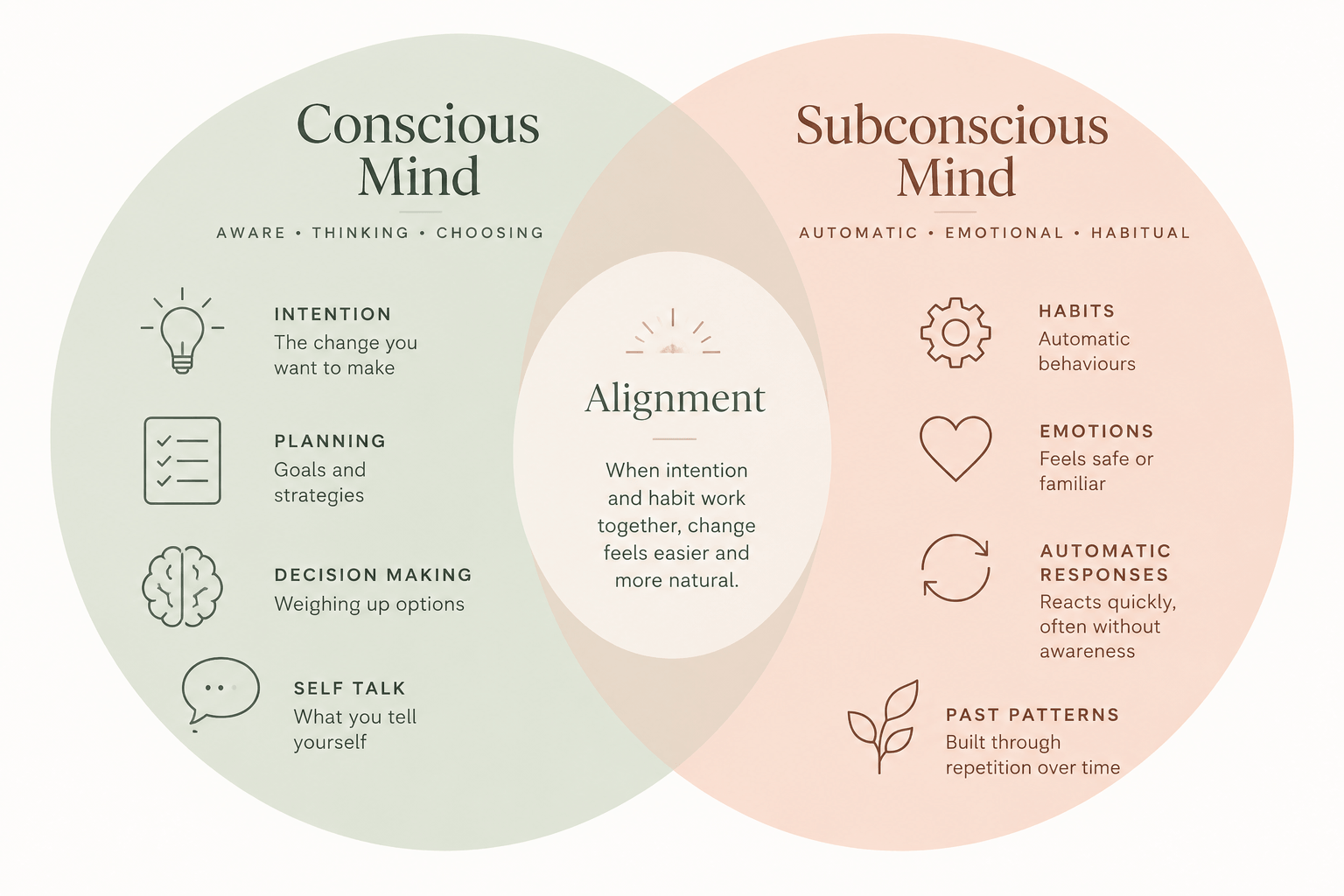
Your conscious mind is where intention lives: the decision to change, the goal you've set, the plan you've made. Your subconscious mind is where habit lives. It runs automatic responses built up over years, often without your active awareness, so that you don't have to think through every small action or reaction from scratch. When the two are aligned, change feels straightforward. When they're not, conscious effort alone tends to lose out to the automatic pattern underneath it.
The subconscious can be thought of as mental activity outside of your conscious awareness that can potentially come into awareness.
These patterns repeat because they were built through repetition in the first place, often as a way of managing stress, discomfort or uncertainty at some point in the past. A pattern that once helped you cope, whether that was reaching for comfort food, avoiding a difficult conversation or bracing for criticism, can stay in place long after the situation that created it has changed. The mind doesn't automatically update these patterns just because your circumstances are different or you've consciously decided you want something else, which is exactly why the same thought loops and behaviours can keep showing up long after they've stopped being useful.
Take comfort eating as an example. One woman loved climbing trees when she was a child. One day she lost her grip and fell. She was very agile, and fortunately avoided breaking any bones, but she was hurt and needed comfort. Her brother had significant disabilities, and understandably, much of her mother's attention and energy went towards caring for him. Even as a child, she was aware of how much her mum had on her plate and didn't want to add to her worries. So instead of seeking comfort from her mum, she found another way to soothe herself: she reached for a tin of biscuits.
It worked, the biscuits provided comfort and helped her feel better. And over time, when she felt upset, hurt or in need of comfort, food became a familiar way of soothing herself. Years later, the original circumstances were long gone, but the pattern remained. She found herself reaching for food almost automatically when she felt stressed, overwhelmed or upset—even when she wasn't physically hungry.
What began as a way of finding comfort had become a learned response. At one point, it had served a very real purpose. The challenge was that her mind had continued to use the same response long after the circumstances that created it had changed.
Why Willpower Alone Rarely Creates Lasting Change
Willpower operates from the conscious mind, and it's genuinely powerful in the short term. It's what gets you through the first few days of a new routine or helps you say no in a moment of temptation. But when it's working against an established subconscious pattern, it's essentially in a tug of war with a much older, more automatic system. That system tends to win once conscious effort runs low, whether that's at the end of a long day, during a stressful week or when you're tired, unwell or distracted.
This tug of war shows up in many areas of life. It might look like reaching for a cigarette under stress despite genuinely wanting to quit, or comfort eating after a difficult day. It might be a pattern of self-doubt that persists despite real evidence of your capability, or procrastination that kicks in exactly when a task requires attention. In each case, the conscious mind wants one thing and the subconscious pattern delivers another, which is why so many people end up feeling frustrated with themselves rather than recognising that they've been relying on the wrong tool for the job.

How Hypnotherapy Works With the Subconscious Mind
What a Hypnotherapy Session Actually Involves
A hypnotherapy session involves guiding you into a focused, relaxed state, where you become more receptive to focused suggestions and perspectives. It's not sleep, and it's not losing control. It's closer to the kind of focused absorption you might already experience while watching a film, reading a good book or getting lost in a task. Our What To Expect page walks through exactly what a session looks like from start to finish.
That relaxed state matters for another reason too. Subconscious change tends to happen more readily when the nervous system feels safe and settled, rather than in a heightened stress state. When the body is braced for threat, even perceived, the mind tends to hold on tightly to what's familiar. Creating calm first gives new patterns the conditions they need to take hold, rather than being met with resistance.
Solution Focused Clinical Hypnotherapy and NLP, Explained Simply
Solution Focused hypnotherapy concentrates on where you want to get to, rather than dwelling extensively on the origin of a pattern. Instead of spending session after session revisiting the past, the focus is on the future you're working toward and the small, practical shifts that move you closer to it. This approach often works alongside NLP (Neuro-Linguistic Programming) techniques, which support new, more helpful ways of thinking and responding.
Together, these approaches aim to work with the subconscious directly, rather than relying purely on conscious willpower to hold a new behaviour in place. The goal isn't to force change through effort, but to make the new way of responding feel more natural over time.

In the first session, I take the time to listen and understand what's been happening for you, what you'd like to change and, importantly, how the pattern is showing up in your life. We don't need to uncover every detail of your past for change to take place. Instead, I meet you where you are and gently guide you through the process using the techniques and approaches that are most appropriate for you.
Many clients are surprised by how natural the experience feels. You remain aware throughout the session and can talk to me at any point. Afterwards, some people notice an immediate shift; for others, the changes are more subtle at first—a thought that doesn't seem quite as compelling, a reaction that feels less intense, or simply a little more space between what happens and how they respond. Sometimes it's the moment you realise you're responding differently without having to try so hard.
What Subconscious Change Can Look Like in Practice
Everyday Examples Across Anxiety, Habits and Confidence
Subconscious change rarely arrives as one dramatic moment. More often, it shows up quietly in everyday life. It might look like noticing anxious thoughts arise and settle more quickly, rather than spiralling, something our Anxiety & Stress service page covers in more depth. It might look like a habit or repeated behaviour losing its grip, which is central to our Addictions & Habits service, or emotional eating patterns easing as the underlying driver is addressed, which our Weight Management service page explores further. It can also show up as steadier day-to-day confidence, something we work on directly through our Self-Esteem & Confidence support.
The number of sessions and pace of progress vary depending on your goals and circumstances. Some people come in with one clearly defined habit, while others are working through patterns that touch several areas of life. Whatever your goal is, the approach and plan are always personalised to suit your individual needs.
Is Hypnotherapy Safe and Evidence Informed?
Hypnotherapy is an evidence-informed therapeutic approach, and research has explored its use across a range of conditions. One area where there is particularly interesting research is irritable bowel syndrome (IBS).
A randomised clinical trial conducted by researchers at Monash University compared gut-directed hypnotherapy with a low-FODMAP diet and a combination of both in people with IBS. At six weeks, 72% of participants receiving hypnotherapy achieved a clinically meaningful improvement in their overall gastrointestinal symptoms. Six months later, 74% of those in the hypnotherapy group continued to show that level of improvement. The study also found improvements in some psychological measures, including anxiety and depression.
This is consistent with information from the National Center for Complementary and Integrative Health (NCCIH), which reports evidence that gut-directed hypnotherapy can help relieve IBS symptoms and improve quality of life. NCCIH also notes a growing body of research suggesting hypnosis may help with some pain conditions. The strength of the evidence varies depending on the issue being addressed, however. For example, research into hypnosis for smoking cessation has produced conflicting results, while evidence for anxiety related to medical or dental procedures is not yet conclusive.
Visit our Research & Resources page if you’d like more information about the approaches we use, and the Australian Society of Clinical Hypnotherapists for information on professional standards and accreditation.
Hypnotherapy Is a Collaborative Process
Hypnotherapy isn't something that is done to you. You remain aware throughout the session and actively participate in the process. You can talk, ask questions, pause or stop at any time.
Being in hypnosis doesn't mean handing over control or doing things that go against your values or wishes. Suggestions are offered for you to consider, and you remain able to accept or respond to them in your own way. In that sense, the process is collaborative: we work together towards the changes you want to make.
For me, creating that sense of safety and choice is an important part of every session. There is no need to force anything. The aim is to create the right conditions for you to explore different ways of thinking, feeling and responding at a pace that feels appropriate for you.
Taking the First Step with The MindShift Clinic
Our free 15-minute consultation gives us a chance to understand what you're working with and talk through whether hypnotherapy is a good fit, with no pressure or obligation attached. It's an opportunity to ask questions, share what you'd like to change and get a feel for how I work. You can learn more about Katarina McNamara's approach and background before you book.
We see clients in person across Sydney's Northern Beaches, with clinics in Balgowlah and Allambie Heights, alongside telehealth options for those further afield.
Frequently Asked Questions
-
A subconscious pattern is an automatic thought, emotional response or behaviour that runs outside of conscious awareness, typically built through repetition over time. It operates independently of conscious intention, which is why simply deciding to change something doesn't always translate into lasting change on its own.
-
Because habits can become automatic. You may consciously want to do something differently, while another learned response is being triggered almost automatically. Willpower can help you override that response, but it can be difficult to sustain change through willpower alone when the underlying pattern remains unchanged.
-
Willpower relies largely on conscious effort to guide your behaviour. That can become more difficult when you’re stressed, tired or emotionally overwhelmed. Hypnotherapy aims to shift the underlying pattern itself rather than relying on ongoing conscious effort to override it.
-
Yes. You remain aware throughout the session and actively participate in the process. You can talk, ask questions, pause or stop at any time. It's a focused, relaxed state, not sleep or unconsciousness.
-
The number of sessions and pace of progress vary depending on your goals and individual circumstances. Together, we will discuss a personalised approach that takes into account what you’re hoping to achieve, as well as what feels right for you.
Ready to Understand What's Really Driving the Pattern?
Change that only relies on willpower tends to be exhausting and short-lived, because it's working against, rather than with, how the automated behaviour actually works. Understanding the pattern is the first real step toward shifting it. If you'd like to explore how this connects to physical and emotional healing more broadly, our companion article on healing through hypnotherapy is a natural next read.
Book your free 15-minute consultation with The MindShift Clinic.