
If you've seen "tapping" mentioned across our site and wondered what it actually involves, read on. Intention-based energy tapping and Clinical Hypnotherapy are different techniques, each offering a unique way to work with emotional and subconscious patterns. In this article, we'll explain what each involves, how they differ, and why we often combine the two when working with clients at The MindShift Clinic.
Two Different Techniques, One Shared Goal
Both approaches aim at the same thing: helping you change patterns that have been sitting under the surface dormant for a long time, sometimes many years. Whether that's anxious thinking, a habit, a stuck emotional response or simply something you might not be able to clearly articulate yet. They go about it differently though.
A quick summary of what each approach involves
Intention tapping involves tapping gently with your fingertips on specific acupressure points on the head, face, upper body and hands while focusing on what you want to change. Hypnotherapy involves guiding you into a focused, relaxed state, where the subconscious mind becomes more open and receptive to suggestions so that a desired change can be initiated faster. One is active and hands-on, and the other is more inward, but still active.
What Is Intention-Based Energy Tapping?
Intention-based energy tapping is a gentle, energy psychology technique. It’s hands-on, as you tap lightly on a set of points, stimulating meridians, while keeping your attention on a thought, emotion, felt sensation, image or in other words, your own problem in your own way. It's closely related to the better-known EFT tapping (Emotional Freedom Techniques), which uses the same basic method of tapping, but the approach is different. The approach used in Intention Tapping was developed by Dr David Lake and psychologist Steve Wells and it’s called Simple Energy Technique (SET). It’s a simpler and more user-friendly version of tapping. More information can be found here https://intentiontapping.com/tapping/
When engaged in tapping, you're present and paying attention. It’s easy to follow and many people feel a rapid emotional and physiological relief. It can be used between sessions as a remedial tool, as well as an energy toning tool to build positive energy over time.
The research is still developing. Dr Peta Stapleton at Bond University is one of Australia's leading researchers in the field of energy psychology, and her work has explored EFT tapping for concerns such as anxiety, depression, weight issues, trauma, pain, phobias. You can find more information here. Whilst results vary between people, and it’s not a guaranteed fix, it’s worth noting that energy psychology has more published research than 90% of psychotherapy modalities and the percentage of studies which indicate effectiveness of tapping is 99%.

What Is Clinical Hypnotherapy?
Clinical hypnotherapy guides you into a focused, relaxed state, often called hypnosis, where you're aware and in control, but more receptive to change. Hypnosis can also be conversational, meaning it doesn't always require a formal relaxation or trance process. It works with the subconscious mind, where many of our habits, beliefs and automatic responses are formed and maintained.
Our guide to subconscious patterns and hypnotherapy explains how this works in more depth, and our What To Expect page walks through a session step by step.
If you're comparing practitioners, the Australian Society of Clinical Hypnotherapists sets out professional standards and accreditation for the hypnotherapy side. A clinical hypnotherapist Northern Beaches clients choose should work to those standards.
Tapping vs Hypnotherapy: Key Differences
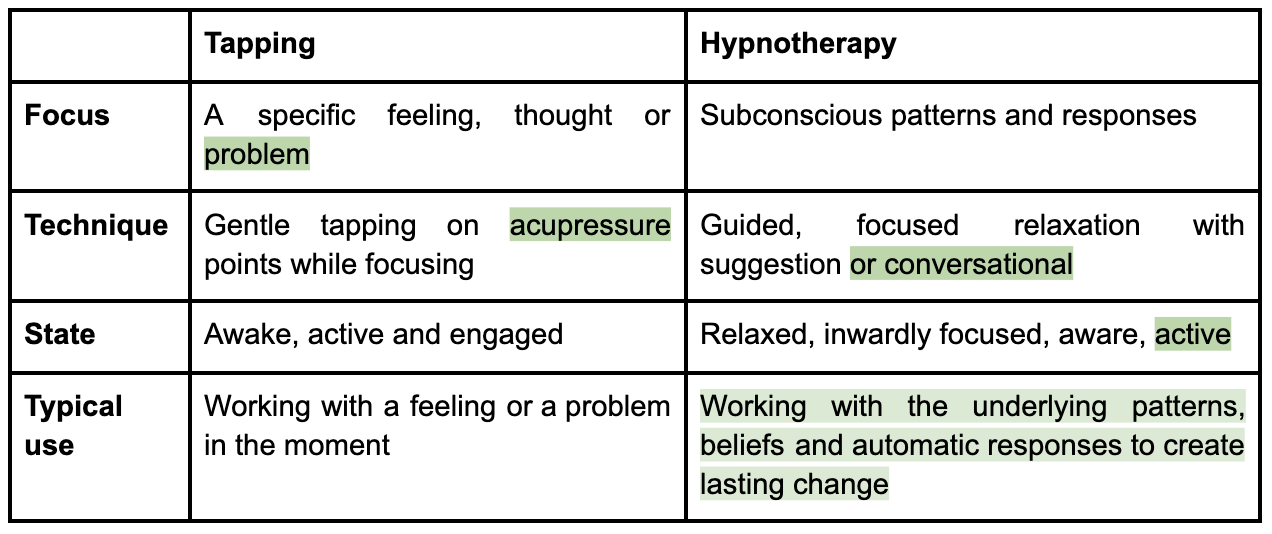
Here's tapping vs hypnotherapy at a glance:
How each technique accesses change
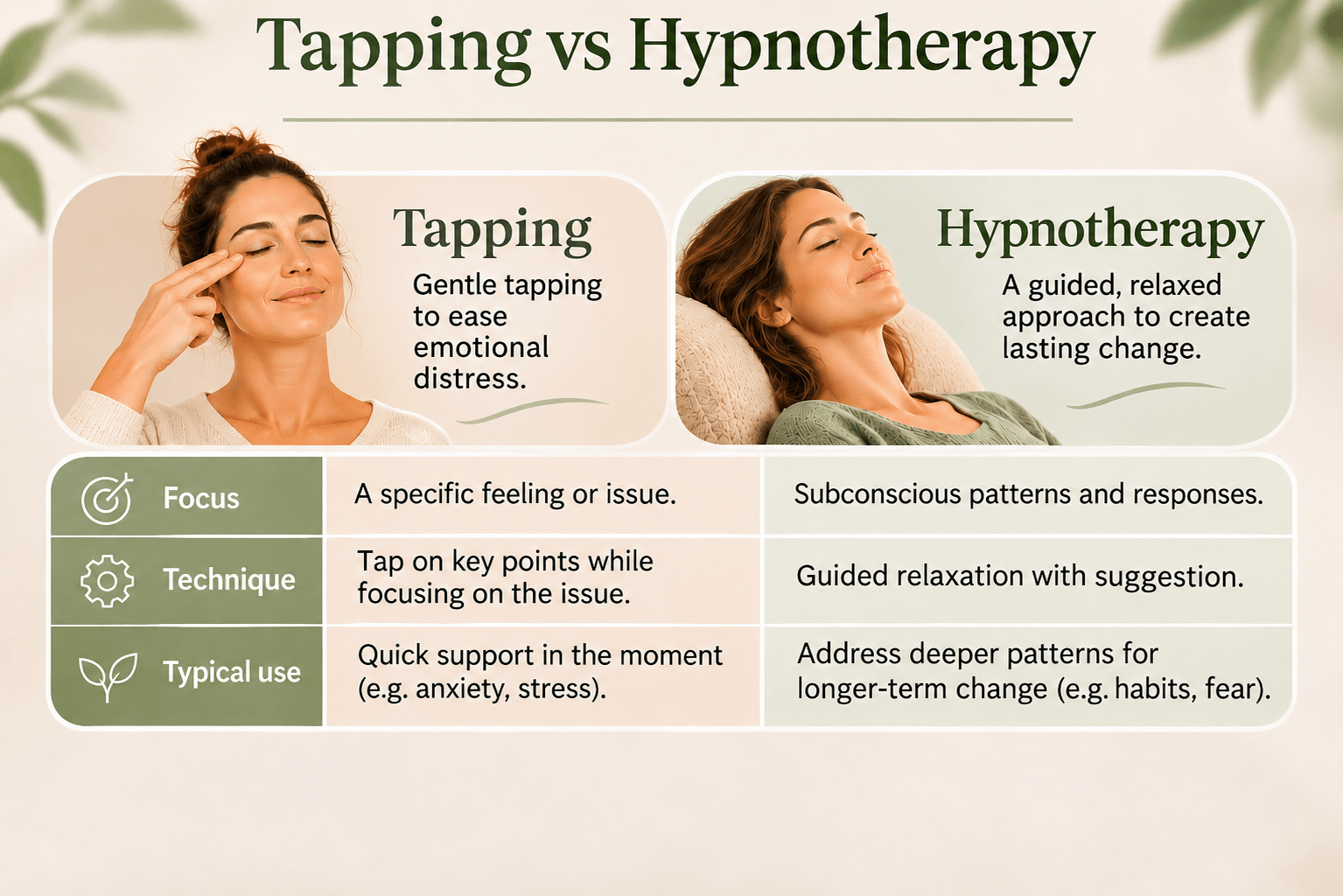
Tapping works through placing attention on a feeling or a problem while you simply tap on specific points on your body. Hypnotherapy works through a focused, receptive state, where suggestions, new perspectives and ways of responding can be explored more easily. Both techniques offer ways of working with patterns that may sit beyond purely conscious awareness or effort.
Why Combine Tapping and Hypnotherapy?
Used together, the two techniques cover more ground than either alone. Tapping gives you a fast, active way to settle and work with what you're feeling, and hypnotherapy works with the patterns underneath. We find the combination gives a more rounded, personalised approach than a single off-the-shelf method.
How the two techniques complement each other in a session
In a session, tapping can help bring down the intensity of a feeling so you can think clearly about it. Hypnotherapy can then work on the pattern behind it. The two support each other, and the balance shifts depending on what you need that day.
What this looks like in practice at The MindShift Clinic
For anxiety, stress, overwhelm tapping can help settle the feeling in the moment while hypnotherapy works with what’s driving that feeling, what’s behind it. Our Anxiety & Stress service page covers this approach. For cravings and habits, tapping can help with the urge as it arises while hypnotherapy addresses the pattern, which our Addictions & Habits service page explains in more detail.
A Note From Katarina: Why I Use Both in My Practice
Kat's own reflections on combining the two techniques
I'd been interested in training in tapping for some time, having experienced firsthand how beneficial working with our body's energy and shifting our emotional state can be.
The moment that really reinforced my intention came when a client arrived for an appointment feeling so anxious about the issue they wanted to address that they were struggling to get their words out. Fortunately, my training had equipped me with techniques I could use straight away to help them move out of that overwhelmed, unresourceful state and become more comfortable engaging in the session.
After completing my Level 1 training in Intention-based Energy Tapping (IEP), I never looked back. I've found it to be an incredibly versatile tool, and one of its greatest advantages is that it can be used discreetly, almost anywhere: at work, in meetings, on public transport or when navigating challenging personal situations.
I've since incorporated tapping into my work with clients experiencing a range of challenges, including anxiety, emotional overwhelm, sports performance, uncomfortable bodily sensations and difficulties with focus and self-regulation. I've also found it a valuable tool when working with clients with ADHD.
The feedback has been overwhelmingly positive. Clients often tell me how valuable they find tapping, not only during our sessions but also as a practical technique they can take away and use independently in everyday life.

Getting Started at The MindShift Clinic
If you'd like to understand which approach, or which combination, might suit you, we're happy to talk it through. We see clients across Sydney's Northern Beaches, with clinics in Balgowlah and Allambie Heights. You can read more about Katarina McNamara and her training, or book a free consultation to get started.
Frequently Asked Questions
-
It's a gentle energy psychology technique where you tap lightly on specific acupressure points on the upper body while focusing on a feeling, thought or problem. It's closely related to EFT tapping and is used alongside hypnotherapy at The MindShift Clinic as part of a personalised approach to change work.
-
They share the same basic method of tapping on specific points while focusing attention, but the approach is different. The approach is called Simple Energy Technique (SET) and it was developed by an Australian medical doctor in collaboration with a psychologist from Western Australia. It’s a simpler and more user-friendly version of tapping. If you'd like to know exactly how it's used in session, ask Katarina during your free consultation.
-
Tapping and hypnosis are both active. With tapping, you tap on the acupressure points alongside with Katarina, focusing on a feeling or a problem. Hypnotherapy guides you into a focused, relaxed state where the subconscious mind is more open to suggestions and change. Both can help shift patterns, and they work in different ways.
-
Yes. They complement each other, so they can be combined in one session. How much of each is used depends on what you're working on, what your emotional state is and also your preference as the treatment plan is always client centric.
-
There is a growing body of research, including work by Dr Peta Stapleton at Bond University exploring tapping for concerns such as anxiety and food cravings. The evidence is still developing and results vary, so tapping is best seen as a promising technique, not a guaranteed fix.